
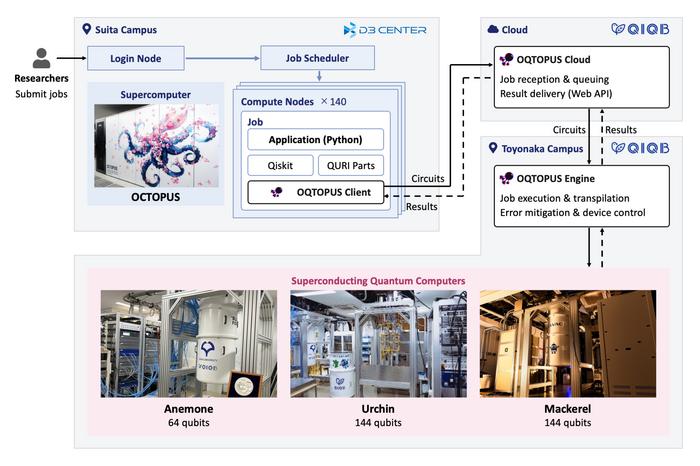
Researchers at the University of Osaka in Japan have developed a hybrid computing platform that connects the university’s OCTOPUS supercomputer with domestically developed superconducting quantum computers.
Named SEAFOOD, the platform enables both technologies to operate within a single computing workflow, allowing researchers to combine quantum processing with conventional high-performance computing. The university describes the integration as the first in Japan to connect a domestically developed quantum computer with a supercomputer installed at the same institution.
The system has already demonstrated its capabilities through a quantum chemistry calculation, with potential applications in materials science, drug discovery, and other computationally demanding fields. SEAFOOD is scheduled to begin operations in December 2026.
SEAFOOD Combines Quantum and Conventional Computing
Understanding interactions between electrons is essential for developing new materials and medicines. However, accurately modelling these interactions requires extensive computational resources, often pushing even powerful supercomputers to their limits.
Quantum computers offer a potential way to address some of these challenges, but existing machines face limitations involving the number of available qubits and computational errors.
The SEAFOOD platform aims to combine the strengths of both technologies rather than relying on either system independently.
Developed through collaboration between the university’s D3 Center and Center for Quantum Information and Quantum Biology (QIQB), the platform connects the OCTOPUS supercomputer with superconducting quantum computers operated by QIQB on a separate campus.
The project involves joint research led by Professor Susumu Date of the D3 Center and Associate Professor Hiroshi Ueda of QIQB.
Open-Source Software Enables Communication Between Systems
The platform uses OQTOPUS, an open-source software framework developed by QIQB and its research partners.
Through this interface, computing jobs submitted to OCTOPUS can send quantum circuits directly to the quantum computers and receive their measurement results. The supercomputer handles conventional computational tasks, while the quantum processors perform operations suited to quantum computing.
This arrangement allows both systems to contribute to a single calculation without requiring researchers to manage them as entirely separate computing environments.
The integration provides scientists with a shared infrastructure for developing and testing hybrid quantum-classical algorithms.
Four-Hydrogen-Atom Experiment Demonstrates Platform
To demonstrate SEAFOOD’s capabilities, the researchers conducted a quantum chemistry calculation using a method called quantum-selected configuration interaction (QSCI).
The approach combines quantum measurements with conventional computational methods. The quantum computer identifies important electron configurations, while the supercomputer carries out the matrix calculations required to determine the system’s energy.
For the demonstration, OCTOPUS was connected to QIQB’s Urchin quantum computer to calculate the ground-state energy of a system containing four hydrogen atoms.
The complete calculation ran through the integrated platform, producing a ground-state energy that matched the result obtained through a conventional reference calculation.
The demonstration established that the two computing systems could successfully coordinate their operations within a single workflow.
University Plans Wider Research Access in 2027
SEAFOOD is intended to provide researchers with a ready-to-use environment for hybrid computing, allowing them to concentrate on developing algorithms and exploring scientific applications.
“SEAFOOD is not simply a connection between a quantum computer and a supercomputer. It is a new kind of research computing infrastructure, built through the collaboration of the D3 Center and QIQB, that brings supercomputing and quantum computing together as an integrated research resource for scientists,” said Professor Date.
During fiscal year 2027, selected research teams at the University of Osaka will receive trial access through the D3 Center’s research proposal-based usage programme, in collaboration with QIQB.
Feedback from these trials will help researchers improve job scheduling, exchange technical knowledge, and explore broader access through national initiatives.
Read More :