
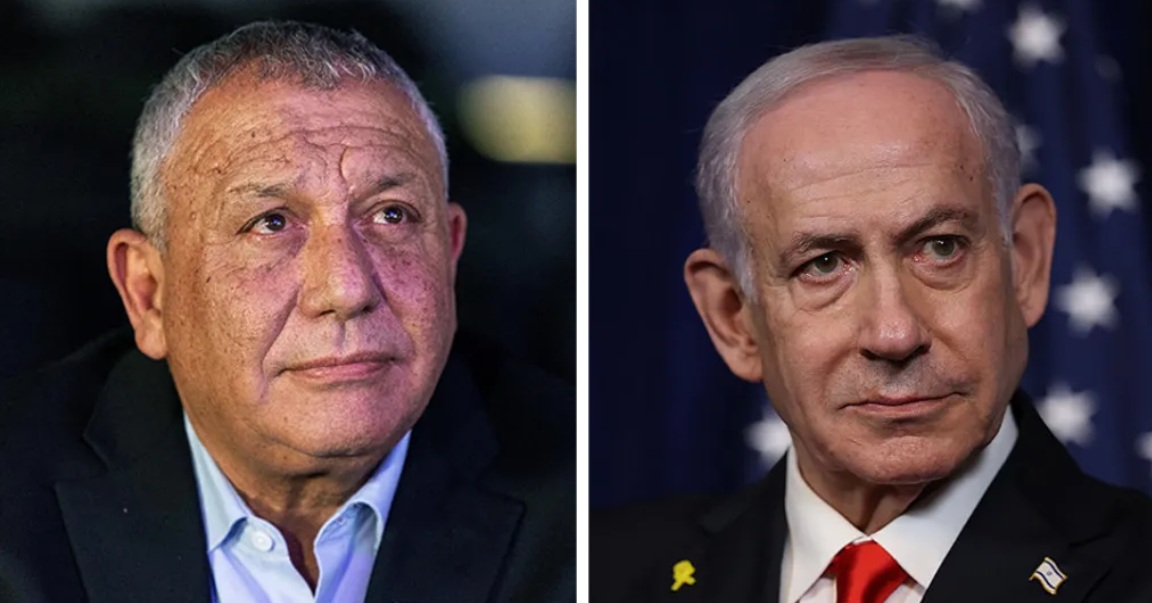
Benjamin Netanyahu’s best chance of staying in power now rests on whether the parties seeking to replace him can agree on a government. His rival Gadi Eisenkot has secured the first opportunity to assemble one, but every available route requires concessions that threaten to divide his camp.
President Isaac Herzog announced on Saturday that he would task Eisenkot with forming an administration, with the formal mandate scheduled for Sunday, November 8. The decision is a setback for Netanyahu after the October 27 election stripped his religious-nationalist bloc of its parliamentary majority. It leaves the outcome of the coalition struggle unresolved.
The distinction matters. Eisenkot has enough endorsements to receive the mandate, but no agreement among those endorsing him on how to govern. Netanyahu can still benefit if those negotiations fail, whether through another attempt to build a majority or pressure for a unity deal.
That gives him a credible route to remaining prime minister. It does not yet make his return the most likely outcome.
Eisenkot’s Numbers Conceal a Political Divide
Eisenkot’s four-party bloc won 48 seats in the 120-member Knesset. Two Arab parties holding another 19 seats endorsed his nomination, bringing his backing to 67 lawmakers. Yet Eisenkot and key partners have resisted relying on Arab parties to take office.
A minority government supported by those parties from outside the cabinet would overcome the numerical shortfall. But Avigdor Lieberman’s Israel Our Home has repeatedly rejected that arrangement since the election. The Democrats have publicly advocated Arab inclusion.
For Netanyahu, that disagreement is an opening. His opponents must either reconcile their positions or find support elsewhere. Their shared determination to remove him cannot, by itself, supply a working coalition.
“Now is the time to form a national emergency government,” Eisenkot wrote on X after Herzog’s announcement.
An agreement with the two ultra-Orthodox parties would offer another route. Their combined 13 seats could give Eisenkot’s camp exactly 61. Such a bargain would require a compromise over military service exemptions for ultra-Orthodox seminary students, which his allies have opposed.
Lieberman suggested some flexibility on Friday, telling supporters, “you cannot have it all”.
That remark is a reason to be cautious about writing off Eisenkot. Negotiations could produce concessions that appeared unacceptable during the campaign. The same political flexibility that gives Netanyahu a route to survival could also enable his rivals to replace him.
How Netanyahu Could Stay in Power
Netanyahu’s bloc holds 53 seats, eight short of a majority. If Eisenkot fails, Netanyahu would likely receive an opportunity to form a government and could try to draw lawmakers away from opposition parties.
A unity agreement offers another possibility. Likud and parts of Eisenkot’s camp could command a majority, but Netanyahu’s opponents would have to abandon their central promise to unseat him. Netanyahu would also face difficult choices over his existing allies. Reuters describes the available coalition options as unlikely at this stage.
His previous comebacks help explain why that possibility cannot be dismissed. Defeated by Ehud Barak in 1999, Netanyahu returned to the premiership in 2009 and remained there for 12 consecutive years.
In June 2021, a coalition spanning right-wing, centrist, left-wing and Arab parties removed him. Its narrow majority and internal disputes proved difficult to manage. Netanyahu stayed on as opposition leader, and his alliance’s victory in the November 2022 election brought him back to office that December.
The precedent is relevant, though it offers no guarantee of another recovery. Netanyahu has previously outlasted an administration whose members agreed on removing him but struggled to govern together. Eisenkot must now prevent similar divisions from blocking an administration before it is formed.
For Netanyahu, prolonged bargaining could strengthen the case for a unity agreement among parties unwilling to face another election. For Eisenkot, the opportunity lies in reaching a compromise before that pressure draws his partners toward Likud.
Once formally tasked, Eisenkot will have 28 days to assemble a government, with a possible 14-day extension. If successive attempts by other candidates also fail, Israel would face another election. Netanyahu’s next opening depends first on what Eisenkot can achieve within that negotiating window.