
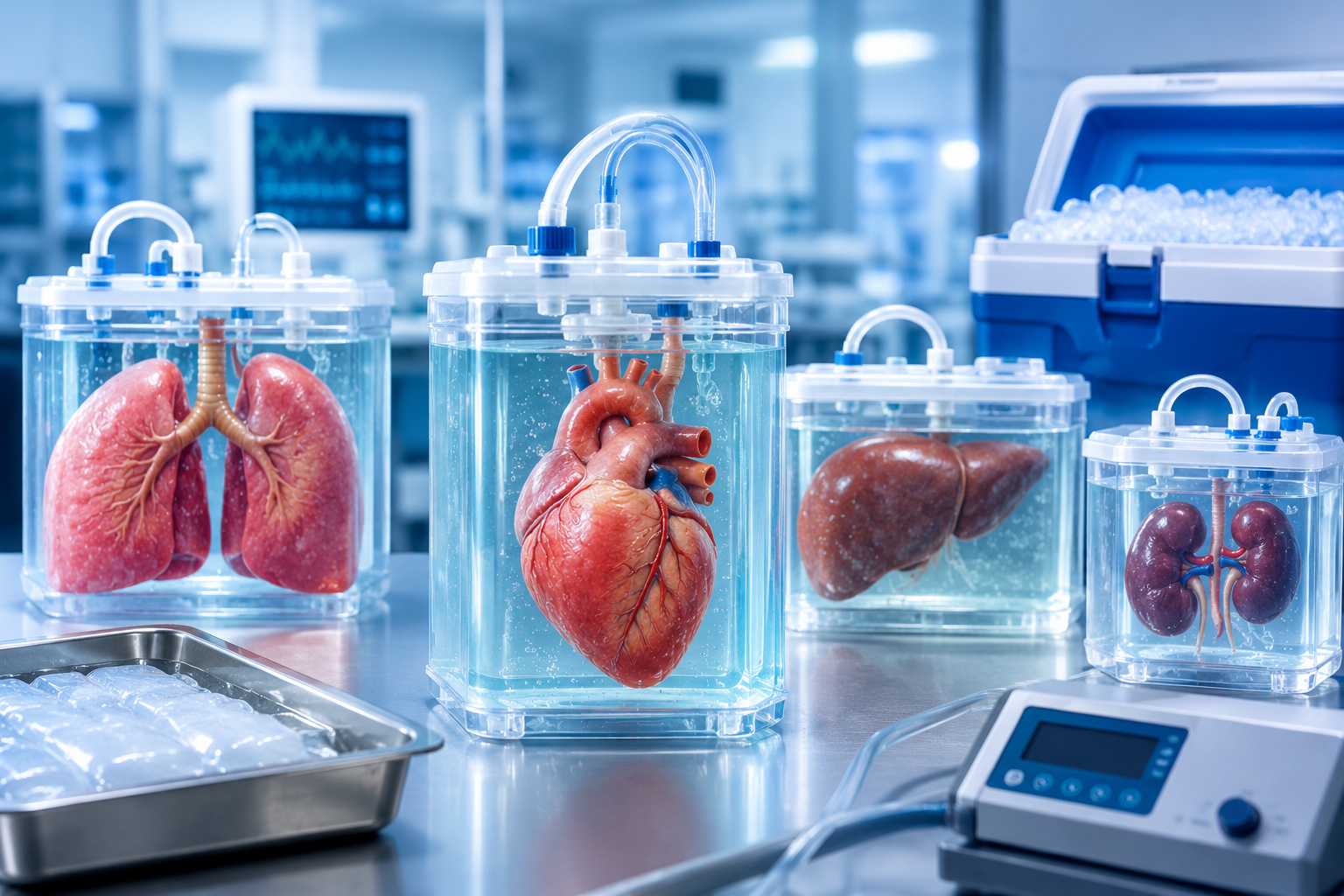
Researchers at the University of Minnesota have achieved a significant milestone in organ preservation by freezing pig kidneys at −150°C (−238°F), storing them for extended periods and successfully transplanting them into test animals after thawing. In one case, a kidney remained frozen for more than a year before being warmed and transplanted, offering a potential new direction for addressing the limited storage time of donor organs.
The findings, reported in a preprint published on bioRxiv that is awaiting peer review, could eventually help transform organ transplantation by allowing organs to be preserved for months or even longer before surgery. The research team, co-led by transplant surgeon Erik Finger, reported that the thawed kidneys regained their colour and enabled the recipient pigs to produce urine, important early indicators of restored blood flow and organ function.
At present, donor organs have strict preservation windows. Hearts and lungs generally need to be transplanted within approximately six hours, while kidneys can remain viable for up to 36 hours under conventional preservation conditions. These limitations complicate the coordination of organ donation, transportation and transplantation.
In the United States, more than 100,000 people are on the organ transplant waiting list, according to the article. Researchers hope that extending the storage period could eventually give medical teams greater flexibility in matching organs with recipients and arranging surgical procedures.
“Ten years ago […] I wouldn’t say I had high hopes it was actually going to work,” Finger told MIT Technology Review on Thursday. “After we did the last transplant, I walked out of the room and said, ‘This is a big deal.’”
Vitrification and nanoparticle technology help preserve organs
The research builds on earlier experiments by the University of Minnesota team. In 2023, researchers reported successful tests involving frozen rat kidneys, followed by a pig kidney transplant experiment in 2025 in which the organ had been frozen for 10 days.
The latest work uses a preservation technique known as vitrification. The process involves immersing biological tissue in a chemical cryoprotective agent (CPA) before cooling it to extremely low temperatures. This creates a glass-like state that helps preserve the tissue while limiting the formation of damaging ice crystals.
According to the research, once the temperature falls below −120°C (−184°F), the vitrified organ can remain stable for extended periods.
“stay stable for long periods of time—we think indefinitely,” Finger told MIT Technology Review, referring to the stability of the organ at these temperatures.
Although vitrification is already used in reproductive medicine to preserve eggs, sperm and embryos, applying the technique to larger organs presents additional challenges. The tissue must be cooled and reheated without causing significant damage, while the protective chemicals must reach the necessary areas without becoming toxic.
To address the rewarming problem, Finger worked with the university’s mechanical engineering department, including bioengineer John Bischof, to develop an iron-oxide nanoparticle solution. The particles were incorporated into the cryoprotectant mixture and can be activated to help warm the organ more evenly.
The researchers designed the approach to reduce temperature differences during rewarming, which can otherwise damage delicate tissue. More uniform heating is particularly important when working with organs much larger than individual cells or embryos.
The successful transplantation results suggest that the method can preserve enough kidney function for the organs to operate after thawing. However, the reported recovery indicators do not, by themselves, establish long-term organ function or prove that the technique is ready for human transplantation.
Human organ preservation remains the next major challenge
The research team’s long-term objective is to adapt the method for human organs, potentially allowing donated organs to be stored for substantially longer than current methods permit.
The project has received support from the US National Science Foundation, which oversees the Engineering Research Center for Advanced Technologies for the Preservation of Biological Systems (ATP-Bio), headquartered at the University of Minnesota Twin Cities.
Mehmet Toner, a professor at Harvard Medical School and ATP-Bio’s deputy director, described the broader potential of the work in a press statement last year.
“The ability to safely pause biological time in a complex organ like a kidney opens the door to truly transformative change in transplantation medicine,” Toner said.
Despite the promising results, researchers acknowledge that substantial technical obstacles remain before the process can be applied safely to human organs. Larger organs require more complex cooling and warming procedures, while the distribution, stability and biological toxicity of cryoprotective chemicals must be carefully controlled.
Finger and his colleagues outlined these limitations in their preprint, writing: “Scaling organ vitrification to human dimensions shifts the challenge from rewarming alone to the integrated problems of cooling, [cryoprotective agent] stability, CPA transport and biological toxicity.”
These challenges mean that the latest results should be viewed as an experimental advance rather than an immediately available medical treatment. Further research will be needed to establish whether the technique can preserve larger organs reliably, maintain their function over time and meet the safety requirements for clinical transplantation.
Read More :