
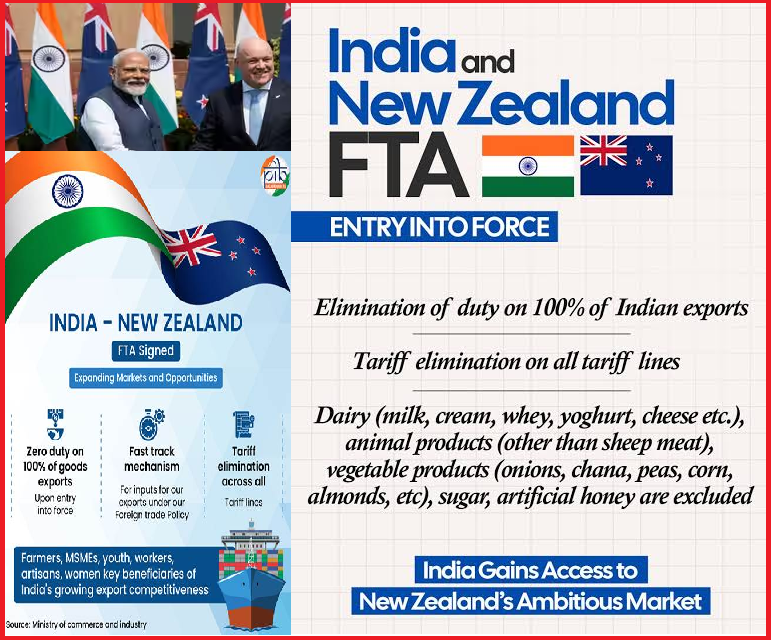
NEW DELHI, October 20: The India-New Zealand Free Trade Agreement (FTA) has entered into force with New Zealand committing to facilitate US$20 billion in investment into India over 15 years, setting up a long-term test of whether the trade pact can translate its headline ambition into identifiable projects, capital inflows and jobs.
The agreement, signed on April 27, 2026, is intended to deepen economic ties between the two countries and expand opportunities in manufacturing, agriculture, infrastructure, start-ups and innovation. However, the investment commitment is a target for facilitating investment, not evidence that US$20 billion has already been committed to specific projects or transferred into India.
The government has said the investment is expected to support entrepreneurship, employment generation and the Make in India initiative. The next challenge will be to identify the projects, investors and timelines through which the commitment can be delivered.
Union Commerce and Industry Minister Piyush Goyal and New Zealand Minister for Trade and Investment Todd McClay announced the agreement’s entry into force on October 19, a day before it became operational.
Commerce Secretary Rajesh Agrawal said the agreement could help India deepen its economic engagement with New Zealand and attract greater investment.
“The job is now to translate this opportunity into actual benefits for our people,” Agrawal said, according to a Commerce Ministry statement.
His remarks underline the central question facing the agreement: how quickly can the investment ambition be converted into commercial activity that can be measured?
Investment target needs project-level milestones
The US$20 billion commitment forms part of a broader effort to expand trade and economic cooperation between the two countries. The investment is expected to benefit sectors including agriculture, manufacturing, infrastructure and start-ups.
The agreement also supports an aspirational target of doubling bilateral trade in goods and services to NZ$7 billion, equivalent to approximately ₹35,000 crore, by 2030.
New Zealand’s Ministry of Foreign Affairs and Trade lists annual two-way trade between the countries at NZ$3.95 billion. The trade target and the investment commitment are separate measures: one concerns trade flows, while the other concerns the facilitation of investment over a longer period.
The distinction matters because an investment target cannot be assessed solely through announcements of interest, memoranda of understanding or proposed projects. Actual capital deployment, project completion and additional productive capacity provide stronger evidence of delivery.
The government has not, in its October 19 announcement, provided a consolidated list of projects that would account for the full US$20 billion, with investment amounts, locations, implementation schedules and employment estimates.
Such information will be important for assessing whether the agreement produces new investment or primarily supports projects that would have proceeded independently.
The investment pipeline will also need to be examined by sector. Manufacturing projects may require land, infrastructure, skilled workers and domestic supplier networks. Agricultural investments could involve food processing, cold chains, technology and supply-chain improvements. Start-ups and technology businesses may depend on funding availability, market access and regulatory conditions.
The agreement’s Investment Desk is intended to assist investors through the investment process. Its effectiveness will depend on how it coordinates approvals, addresses operational difficulties and helps companies move from initial enquiries to projects.
Jobs, regional distribution and accountability will determine success
The investment commitment also raises questions about the geographical distribution of projects and their employment impact.
Large investments concentrated in a few industrial centres could increase output without spreading the benefits widely. Projects involving local suppliers, smaller businesses, technology transfer and workforce training could create broader economic benefits.
The government has emphasised opportunities for MSMEs and entrepreneurs under the FTA. But the investment announcement does not yet establish how much capital will reach smaller enterprises, how many jobs will be created or which states will receive the largest share of investment.
The agreement’s implementation should therefore be assessed against measurable indicators, including actual capital inflows, the number and value of projects reaching financial closure, projects under construction, operational facilities, employment generated and procurement from Indian suppliers.
It will also be necessary to distinguish new investment from reinvested earnings, acquisitions of existing businesses and previously announced projects. These categories can have different implications for additional productive capacity and employment.
New Zealand has presented the agreement as an opportunity to expand the presence of its businesses in India. The pact also gives Indian exporters zero-duty access across all tariff lines in the New Zealand market, potentially strengthening the commercial case for investment in export-oriented production.
The two countries now face the implementation phase. The US$20 billion commitment provides a substantial headline objective, but its economic significance will depend on the projects that emerge, the capital actually deployed and the benefits that reach businesses and workers.
The first meaningful test will be the publication of a transparent investment pipeline, with sector-wise allocations, project milestones and a regular mechanism for reporting progress. Without those details, the commitment will remain an ambition rather than a measurable account of economic delivery.