
Escalating tensions involving Iran have unsettled global financial markets, with Indian equities and the rupee facing pressure as investors react to rising crude oil prices and geopolitical uncertainty in West Asia.
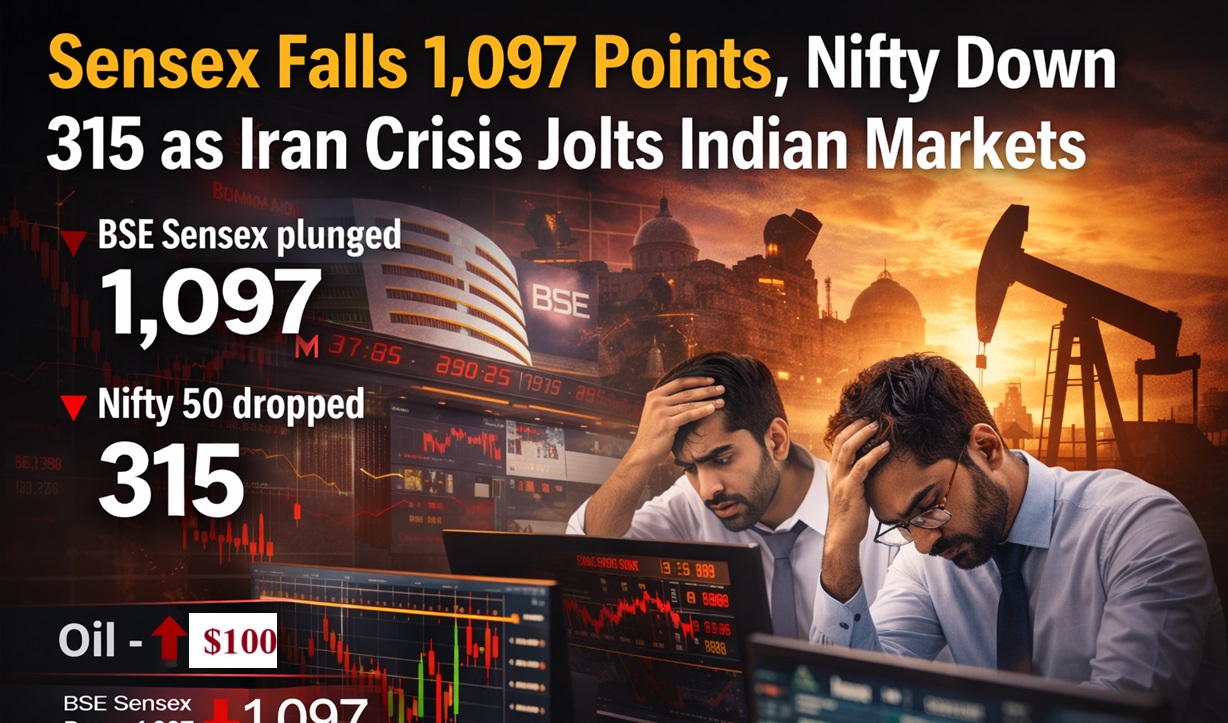
Domestic benchmark indices slipped sharply in recent sessions as risk sentiment weakened. The BSE Sensex fell about 1,097 points, or 1.4 per cent, to close at 78,918.90, while the Nifty 50 dropped 315 points, or 1.3 per cent, to settle at 24,450.45 as investors turned cautious amid the growing geopolitical crisis.
The broader trend during the week also reflected heightened volatility. The Sensex recorded a weekly decline of about 3.08 per cent, tracking weakness in global markets as oil prices climbed amid concerns about potential disruptions to energy supplies from the Middle East.
For India, the primary risk from the Iran crisis lies in crude oil. Brent crude prices surged sharply, at one point rising above $100 per barrel for the first time in nearly four years as the Iran conflict escalated and Ayatollah Mojtaba Khamenei was chosen as supreme leader.
WTI crude was trading at $108.66, up $17.76 or 19.54%, while Brent crude was at $108.69, up $16.00 or 17.26%, as traders priced in the possibility that an escalation could affect shipments through the Strait of Hormuz, a crucial maritime route for global energy trade.
Heavily Dependent on Oil Imports
India is particularly vulnerable to such shocks because of its heavy dependence on imported oil. The country imports more than 85 per cent of its crude oil requirements, meaning any sustained rise in prices can quickly increase the import bill, put pressure on the rupee and add to inflationary concerns.
Market participants say geopolitical tensions have already injected volatility into equities, with investors shifting to safer assets while trimming exposure to riskier markets.
Ponmudi R., CEO of Enrich Money, said investors should brace for continued swings in the market as geopolitical developments unfold. He said “the week ahead is likely to remain volatile” as tensions in the Middle East continue to shape investor sentiment.
Sectoral impacts are expected to vary depending on exposure to crude oil and global trade flows. Industries that rely heavily on fuel or petrochemical inputs — such as aviation, paints and chemicals — could face pressure on margins if oil prices remain elevated. On the other hand, energy producers and some defence-linked companies could see gains as commodity prices rise and geopolitical tensions increase.
Strait of Hormuz Poses Real Challenge
Another key concern for India is the security of shipping routes. A large share of India’s crude imports passes through the Strait of Hormuz, making any disruption in that corridor a major risk for the economy. Even the threat of disruption can push up insurance and freight costs, raising expenses for importers and exporters alike.
Global investor sentiment has also turned more cautious as the crisis deepens. Analysts note that Indian equity markets have already fallen about 4 per cent within two days of the conflict escalating, underscoring how quickly geopolitical shocks can reverberate through financial markets.
Veteran investor Jim Rogers warned that oil prices could climb further if the conflict intensifies. He said crude “could definitely cross $100 a barrel again” if geopolitical tensions escalate.
Despite the immediate volatility, market observers say the long-term impact on Indian equities will depend on how prolonged the crisis becomes. If tensions ease and oil prices stabilise, markets may recover. However, a prolonged conflict that disrupts energy supplies or shipping lanes could keep Indian markets under pressure in the weeks ahead.
 Arun Kumar N